Introduction: Why Aerodynamics Is the Heart of Formula 1
Formula 1 is not just about raw speed. It is about precision, balance, and engineering excellence. While engines provide power and drivers provide skill, the true secret behind performance lies in something invisible — air.
Aerodynamics in Formula 1 determines how efficiently a car moves through the air, how much grip it generates in corners, and how stable it remains at high speeds. In modern F1, the difference between winning and losing a championship often comes down to fractions of a second — and those fractions are usually found in aerodynamic performance.
From the early days of simple streamlined cars to today’s ground-effect machines, aerodynamic technology has constantly evolved. Teams invest millions in wind tunnels, computational simulations, and research to gain even the smallest advantage.
In this blog, we explore the history of F1 aerodynamics, the revolutionary innovations that shaped the sport, and how modern teams manipulate airflow to dominate races.
The Early Years: When Aerodynamics Was an Afterthought (1950s–1960s)
In the early decades of Formula 1, aerodynamics was not the main focus. Cars were designed primarily around engine performance and mechanical grip. Engineers aimed to reduce drag — the resistance caused by air — but they did not yet fully understand how to use airflow to increase grip.
During the 1950s and early 1960s:
- Cars had simple, smooth body shapes.
- Designers focused on straight-line speed.
- Cornering performance depended mostly on tire grip and suspension.
The idea of generating downforce — pushing the car onto the track using air — had not yet been fully explored.
At that time, aerodynamics was more about reducing lift rather than creating downward pressure. Cars sometimes became unstable at high speeds because air would flow underneath them and create unwanted lift.
Everything changed in the late 1960s.
The Birth of Wings: The First Aerodynamic Revolution
The true revolution in Formula 1 aerodynamics began in 1968 when teams started experimenting with wings.
Inspired by aircraft design, engineers realized that inverted wings could generate downforce instead of lift. By mounting wings onto the car, they could push it onto the track, increasing tire grip — especially in corners.
This innovation transformed racing.
Suddenly:
- Cars could corner much faster.
- Braking stability improved.
- Lap times dropped dramatically.
High-mounted wings were initially placed on tall struts above the car. However, some early designs failed structurally, leading to dramatic crashes. As a result, regulations were introduced to control wing placement and ensure safety.
From that moment, aerodynamics became central to car design.
The Ground Effect Era: The 1970s Revolution
One of the most dramatic changes in F1 aerodynamics came in the late 1970s with the introduction of ground effect.
The concept was pioneered by Team Lotus, particularly with the Lotus 78 and Lotus 79. Engineers shaped the car’s sidepods like inverted wings and sealed the edges with sliding skirts. This created a low-pressure zone under the car, effectively sucking it to the track.
Unlike traditional wings, ground effect:
- Generated massive downforce.
- Created less drag.
- Improved overall efficiency.
Cars became incredibly fast in corners. However, the sudden loss of ground effect — if the car bottomed out or skirts failed — made them unpredictable and dangerous.
Due to safety concerns, the FIA eventually banned sliding skirts and extreme ground-effect designs in the early 1980s.
But the concept never truly disappeared.
The 1980s: Turbo Power and the Aero Arms Race
The 1980s brought turbocharged engines producing enormous power. With increased speed came greater aerodynamic demands.
Teams began:
- Adding more complex front and rear wings.
- Introducing multi-element wing designs.
- Refining diffuser concepts.
- Conducting extensive wind tunnel testing.
Aerodynamics became an arms race.
Engineers started using Computational Fluid Dynamics (CFD) to simulate airflow digitally. Wind tunnel development expanded significantly. Teams realized that performance gains no longer came only from engines — airflow management was equally important.
Balance became critical. Too much downforce increased drag. Too little reduced cornering speed.
Finding the perfect compromise became the goal.
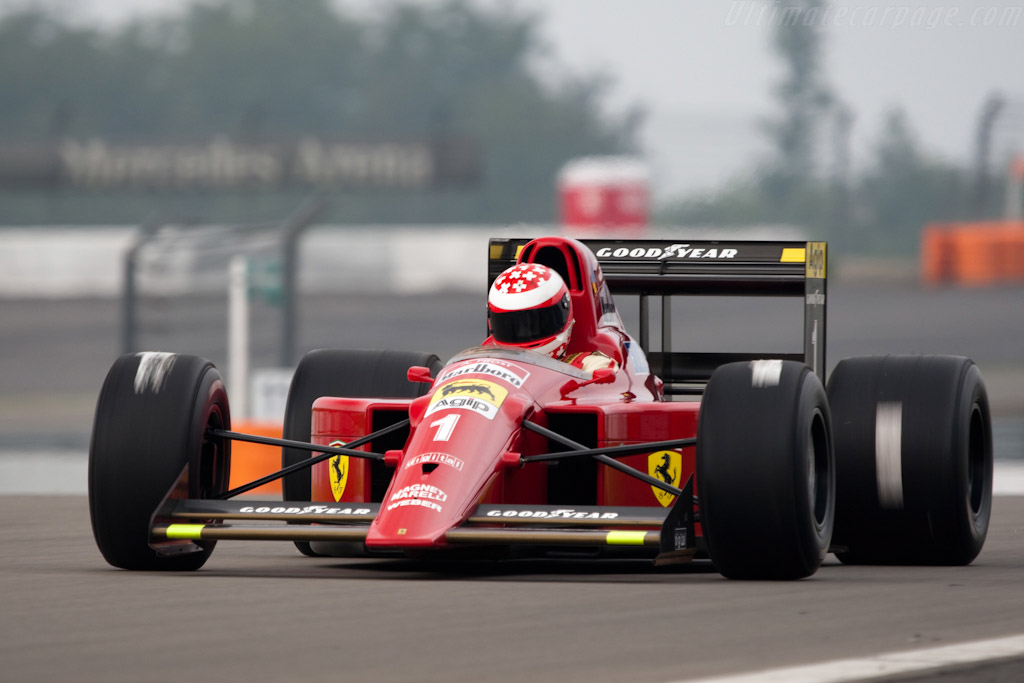
The 1990s: Aerodynamics Becomes a Science
By the 1990s, aerodynamics in Formula 1 had matured into an exact science.
Cars featured:
- Narrow nose cones.
- Highly sculpted sidepods.
- Advanced diffusers.
- Refined underbody airflow.
Engineers studied every millimeter of the car’s surface. Airflow over mirrors, suspension arms, and brake ducts was carefully optimized.
This era also introduced advanced electronics such as active suspension, which helped maintain ideal ride height — crucial for aerodynamic efficiency.
Another major focus during this period was “dirty air.”
When a car moves through air, it creates turbulent airflow behind it. This disturbed air reduces downforce for the car following closely, making overtaking more difficult.
Understanding and managing aerodynamic wake became a critical challenge that still affects racing today.
The 2000s and Early 2010s: Complexity and Innovation
In the 2000s, F1 cars became incredibly complex aerodynamically.
Engineers introduced:
- Bargeboards to manage airflow around sidepods.
- Turning vanes under the nose.
- Double diffusers.
- Flexible wing concepts.
- Blown diffusers using exhaust gases.
Teams pushed regulatory boundaries constantly.
For example, the double diffuser innovation dramatically improved downforce by optimizing airflow at the rear of the car. These creative interpretations of regulations led to huge performance differences between teams.
Aerodynamics became the primary performance differentiator.
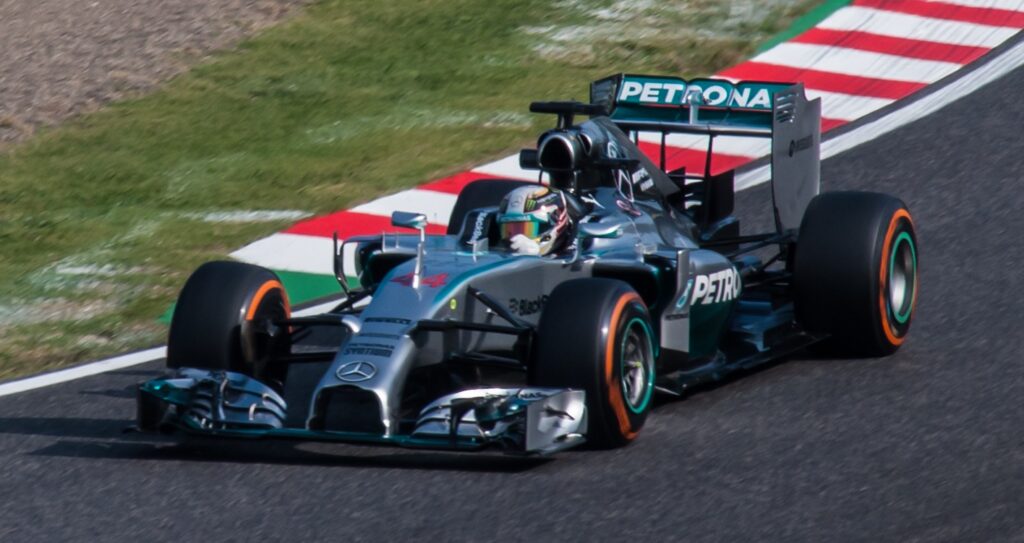
The Hybrid Era: Efficiency Meets Aerodynamics
In 2014, Formula 1 entered the hybrid power unit era.
While engines became more efficient and environmentally conscious, aerodynamics remained the key to lap time performance.
Modern F1 cars feature:
- Multi-element front wings.
- Intricate brake ducts.
- Highly detailed sidepod inlets.
- Complex rear wings.
- Massive diffusers.
- Sophisticated floor designs.
Every surface influences airflow.
Even small details like mirror placement or cooling outlet size can affect aerodynamic balance.
Teams rely heavily on CFD simulations, wind tunnel testing, and advanced modeling tools to refine designs.
The Return of Ground Effect (2022 Regulations)
In 2022, the FIA reintroduced ground-effect principles under new regulations designed to improve overtaking.
Instead of relying heavily on complex upper-body wings, cars now generate more downforce from:
- Venturi tunnels under the floor.
- Shaped underbodies.
- Simplified front and rear wings.
The goal was to reduce dirty air and allow cars to follow more closely.
This regulation shift marked another major aerodynamic evolution.
While teams initially struggled with issues like porpoising (bouncing caused by airflow instability), engineers quickly adapted.
Ground effect once again became the foundation of aerodynamic performance — but in a safer, more controlled form.
Key Principles of F1 Aerodynamics
Understanding F1 aerodynamics comes down to a few core principles.
1. Downforce vs Drag
Downforce pushes the car onto the track, improving grip.
Drag resists forward motion, reducing top speed.
Engineers constantly balance these two forces. A high-downforce setup works well on tight circuits like Monaco, while low-drag setups suit high-speed tracks like Monza.
2. Airflow Management
Managing airflow around:
- Front wheels
- Sidepods
- Rear diffuser
- Underbody floor
Is crucial for maximizing performance.
Even small turbulence can cost valuable lap time.
3. Cooling Efficiency
Aerodynamics also ensures engines and brakes stay cool.
Larger cooling inlets improve temperature control but increase drag. Smaller openings reduce drag but risk overheating.
Again — it’s all about balance.
4. Dirty Air and Wake Control
Reducing turbulent air behind the car is essential for better racing.
Modern regulations aim to limit complex airflow structures that make overtaking difficult.
Modern Tools: Simulation and AI in Aerodynamic Design
Today’s F1 teams rely on advanced tools to design aerodynamic packages:
- CFD simulations
- Wind tunnel experiments
- Laser scanning
- Artificial intelligence models
AI can analyze airflow data faster than traditional methods, allowing engineers to test thousands of variations quickly.
Regulation limits on wind tunnel usage make efficiency even more important. Teams must use their limited testing time wisely.
Innovation continues despite strict rule frameworks.
Why Aerodynamics Wins Championships
A powerful engine alone does not win championships.
The fastest car is often the one that best manipulates airflow.
Aerodynamics affects:
- Cornering speed
- Tire wear
- Fuel efficiency
- Stability
- Overtaking ability
A well-balanced aerodynamic package allows drivers to push confidently and consistently.
Championship battles are often decided by incremental aerodynamic upgrades introduced throughout the season.
One successful update package can shift the competitive order entirely.
Conclusion: The Invisible Force That Defines Speed
From simple curved bodywork in the 1950s to today’s complex ground-effect floors, aerodynamics has transformed Formula 1.
It is an endless battle of innovation, engineering creativity, and regulatory adaptation.
Air cannot be seen, but in Formula 1, it is everything.
The cars that best control airflow are the ones that dominate. As technology evolves, sustainability increases, and hybrid systems advance, one truth remains constant:
The fastest Formula 1 car is not necessarily the most powerful.
It is the one that understands the science of air better than anyone else.
And that invisible advantage — measured in milliseconds — is what decides championships.